


| Damp in a wall caused by a leak doesn't go away on its own. First the source has to be found, then it has to be repaired. If a stain grows, returns after cleaning or has no clear explanation, paint or a dehumidifier is not enough. A specialist engineer needs to locate the source, often using thermal imaging and other non-invasive instruments. |
You notice a dark patch, perhaps damp to the touch. Paint may be peeling, or a musty smell has no obvious source.
Your instinct says something is wrong. It probably is.
Damp in a wall caused by a leak is one of the most common and most misunderstood problems in Greek homes. The reason it's misunderstood: it doesn't always show where it is. The source can be 3 metres away from the stain you see.
This guide explains what you can check yourself and when an IVM specialist engineer should investigate.
Where Wall Damp Comes From — Often Not Where You Expect
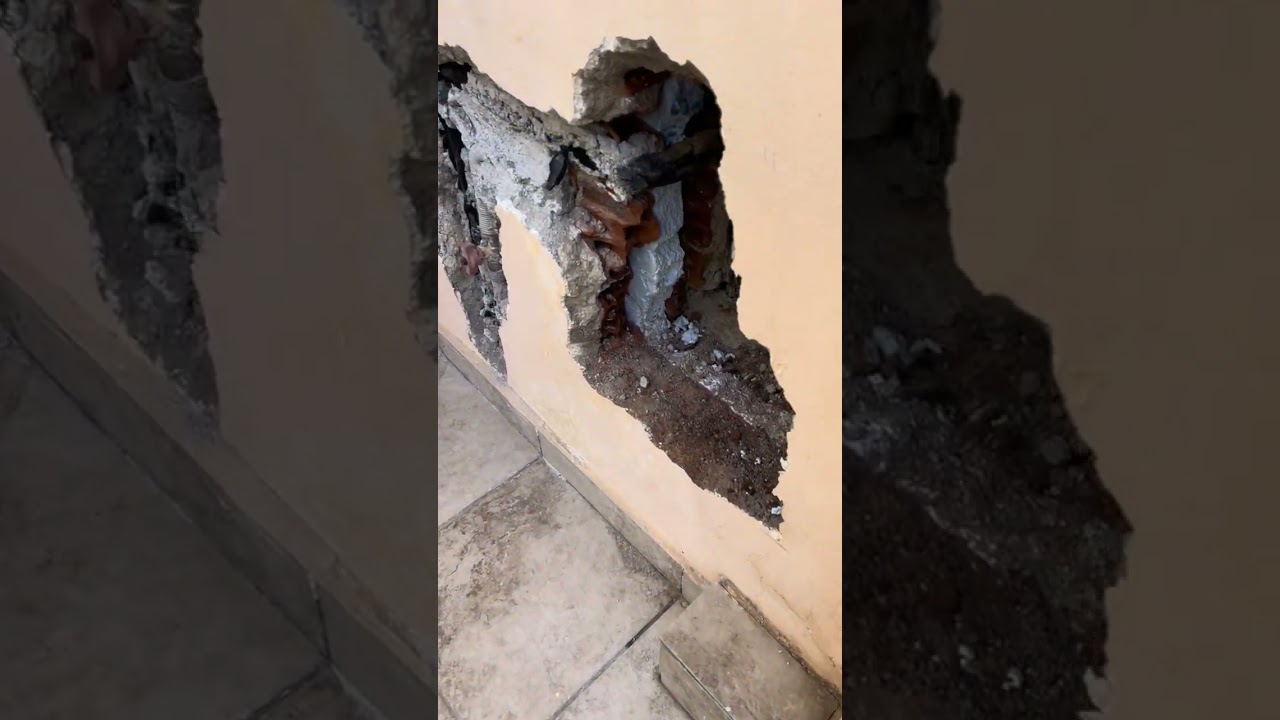
A damp patch on a wall from a leak does not necessarily appear at its source. Water follows gravity and pathways through materials, travelling centimetres or metres before becoming visible. Straightforward plumbing faults can be repaired by your plumber; tracing a hidden source may require an IVM specialist engineer.
Common sources of wall damp include:
- Water-supply or heating pipes within a wall or floor.
- A leak from the bathroom or kitchen upstairs.
- Failed seals around tiles, especially in older bathrooms.
- Rain entering through a roof, doorway or poorly protected external wall.
- Condensation: water vapour turning to liquid on a cold surface.
| Important: Rain entry and condensation are not plumbing leaks and need different treatment. Establishing the cause comes first. Call and ask to speak with one of our specialist engineers; free telephone advice is sometimes all you need. |
Water Leak Inside the Wall: How to Tell Whether It's a Leaking Pipe or Something Else
It is not always obvious whether the damp comes from a leaking pipe or another source. Certain clues can guide an initial assessment.
| Sign | Possible Cause | What You Do |
| A stain appearing after rain | Possible water entry from a roof or external wall | An engineer should investigate waterproofing rather than assume a plumbing fault |
| A stain linked to use, such as after showering | Possible drainage leak or failed waterproofing | Investigate drainage, seals and waterproofing |
| A persistent, growing stain unrelated to weather | Possible pressurised water or heating leak | Prompt investigation by a specialist engineer |
| Droplets on glass or a cold wall | Condensation from humid air | Improve ventilation and thermal insulation |
| A stain near a corner or ceiling | Possible water from upstairs or the roof | Coordinate with the neighbour or building manager |
What You Can Do Without a Specialist — and What You Shouldn't Do
Before you pay to have the wall opened or pipes changed, you need to know what the findings justify. The leak may eventually stop, but that doesn't mean all the ripping out you paid for was needed.
To keep breaking and replacements to what is necessary, as far as possible, IVM's specialised engineer investigates the cause with non-invasive methods. Then they explain the findings to you on the spot and discuss the options with you, based on your priorities and your budget.
See what water leak detection by IVM includes →
Until then, the table below separates what you can do without a specialist from the work that needs an investigation first.
| Checks You Can Make | Avoid Before Diagnosis |
| Ventilate to reduce air humidity | Knocking holes in the wall looking for the pipe |
| Photograph and record changes in the stain each week | Painting over the stain |
| Note whether it coincides with water use upstairs | Applying waterproof paint without knowing the cause |
| Temporarily isolate your own water supply as an observation | Assuming a dehumidifier repairs the problem |
| Record the water meter before and after two hours with no water use | Starting repairs before locating the source |
| The Waterproof Paint Trap: Waterproof paint is often used to conceal damp, only to peel weeks later as moisture continues arriving from behind. It covers a symptom; it does not repair a leak. |

Five Signs You Need Specialist Diagnosis Now
These signs deserve prompt investigation. Professional diagnosis can prevent further damage.
- The stain is growing or spreading to other walls.
- It returns within weeks of cleaning or painting.
- The wall feels wet even when it has not rained.
- Your water bill has increased without a change in use.
- Mould is spreading or there is an unexplained musty smell.
| A Real Example A Chalandri homeowner repainted a bedroom-wall stain twice. Three months later the wall felt soft and the stain had reached the ceiling. An IVM specialist engineer used thermal imaging and other methods to locate a small crack in a heating pipe inside the wall. A small opening allowed repair, avoiding the full wall demolition previously proposed. |
Professional Leak Investigation Without Digging
A hidden-leak investigation may combine a professional thermal imaging camera with other specialist non-invasive equipment. Thermal imaging shows surface temperature differences that may be associated with moisture. The camera alone is not enough: supporting measurements and an engineer’s interpretation are needed to avoid a false diagnosis or pointing to the wrong location.
What this means in practice:
- You don't have to knock holes in walls looking for the pipe
- Investigation during the visit without destructive exploratory work
- If you ask for it, you get a technical report with an engineer's stamp on the likely cause (150 € + VAT)
- Repairs target the evidence to avoid unnecessary demolition and refurbishment caused by an incomplete diagnosis
Why Diagnosis by an IVM Specialist Engineer Can Save Money
“A specialist engineer will cost too much; I will call someone with a thermal camera.” The investigation fee is only one part of the total cost.
| Without Professional Diagnosis by a specialist engineer | With Professional Thermal Imaging |
| Repainting the same returning stain | Identifying or ruling out causes during the first visit |
| You break walls looking for the pipe | Narrowing down the location to minimise the opening |
| The problem continues unnoticed for months | Limiting further spread and damage |
| Mould and potential health effects | A targeted solution, and you know what to keep an eye on afterwards |
| Possible extensive refurbishment in one or two years | Limited work and lower cost instead of unnecessary partial refurbishment |
The questions you often ask us, and what we answer
Will the wall dry out when the weather improves?
Not permanently if a pipe is leaking. Water continues escaping regardless of the weather. The surface may look dry while moisture and material damage continue.
Can I paint over the stain?
You can, but you won't solve the problem. The stain will come back, usually within a few weeks, and the paint will peel. If you haven't found the cause, painting is money lost — and precious time. The damage may grow, and with it the cost of restoration.
How do I know whether the leak is from my own pipe or from the neighbour upstairs?
Temporarily isolating your own water supply for one or two hours and observing changes can provide a clue, but retained moisture and delayed drying mean this is not conclusive. In IVM’s experience from over 5,000 visits, ceiling damage often points upstairs. A thermal image alone cannot establish responsibility: proper investigation by a specialist engineer is needed.
How long can I leave damp untreated?
The less time, the better. Persistent moisture can damage materials, allow mould growth and loosen plaster over weeks or months. Prolonged exposure can also contribute to reinforcement corrosion and spalling, increasing the repair needed.
Does thermal imaging always identify the cause?
Thermal imaging identifies unexplained warm or cool areas. Interpreting the cause requires a specialist engineer, supporting instruments and investigation. A thermal camera alone cannot locate most hidden leaks. A combination of methods is often necessary. A suitable professional camera can provide useful information quickly, provided the operator understands its readings and limitations. The article cites equipment above €5,000 at 2026 prices.

The fee
So that you know, before you break anything, what's wrong and which solution fits you, with a thorough non-invasive (non-destructive) check by a specialised engineer: the fee for water leak or damp detection is 410 € + VAT, with a customer satisfaction guarantee. That is: if for any reason your experience with IVM, from start to finish, didn't satisfy you, you ask for your money back, whenever you want (see our guarantee →). We explain the findings to you on the spot and discuss them together. We investigate one cause, wherever it takes us (what this means →). Your space stays as it was.
That's all for the visit. If there is an insurance policy, we contact its loss adjuster ourselves and send them whatever material they need to make use of the visit, at no extra charge. Only if you also want something in writing for your own reasons, which is optional, there is an extra fee: a technical report stamped by an engineer, 150 € + VAT, or an expert-witness report by a qualified engineer, 300 € + VAT (what each one includes →).
The fee applies from Voula to Kifisia, for homes up to 180 m². For business premises, homes over 180 m² and areas outside this zone, we start from the same fee and the specialised engineer will confirm it when they talk to you — before the appointment. Full details of our fees →
Tell us what you see or call us on 210 513 8501.