


If you're here, you have damp in your home, you don't know where it's coming from, and you want a permanent, reliable and, at the end of the day, cheaper solution. I know, and we see it often. Many homes in this country have the same problem. Inevitably you want a solution, because you're losing heat and you've lost your comfort and your peace of mind. I know well, and I feel, what's on your mind: how do I find the damp without digging? Most of the time it can be done. And when it can't be done completely, by the time we leave you at least know where it isn't coming from.
In many cases, we can substantially narrow down the likely source without exploratory damage. Other cases need further testing or a targeted opening for confirmation. A professional thermal camera alone does NOT pinpoint exactly where the water is inside the wall, the floor or the ceiling; combined with other specialised professional non-invasive (non-destructive) testing equipment, however, the source is found without damage. Additional non-invasive equipment is needed as well, which we have. And of course you also need an engineer who can understand what the data from that equipment means. Reliable interpretation of the measurements requires an understanding of the physics of each method, of the construction and of the possible sources of error. So you often end up with an extensive repair, and somewhere along the way the cause has been found, but in the end you have paid a lot more than for a reliable diagnosis followed by a targeted repair.
The key is not to lose time on trial and error, nor to be taken in by the Trojan horse of a low price when you look for a plumber with a thermal camera. When the source can't be seen with the naked eye. If there is an active water source, delay can increase the extent of the damage. When the cause isn't obvious, the case needs a professional with the right diagnostic method and experience in interpreting the findings.
Do not choose a plumber with a thermal camera to diagnose the damp. Do ask your ordinary plumber to look first, though, because many faults are easier to identify than you expect without anyone pretending to be a scientist. If the answer is “let us open it up and see”, you need engineers experienced in diagnosing damp, mould and leaks. And yes, they exist.
Why you can't find the source without us — and it's not your fault
Moisture travels. That is why the visible damage is not necessarily where the cause is.
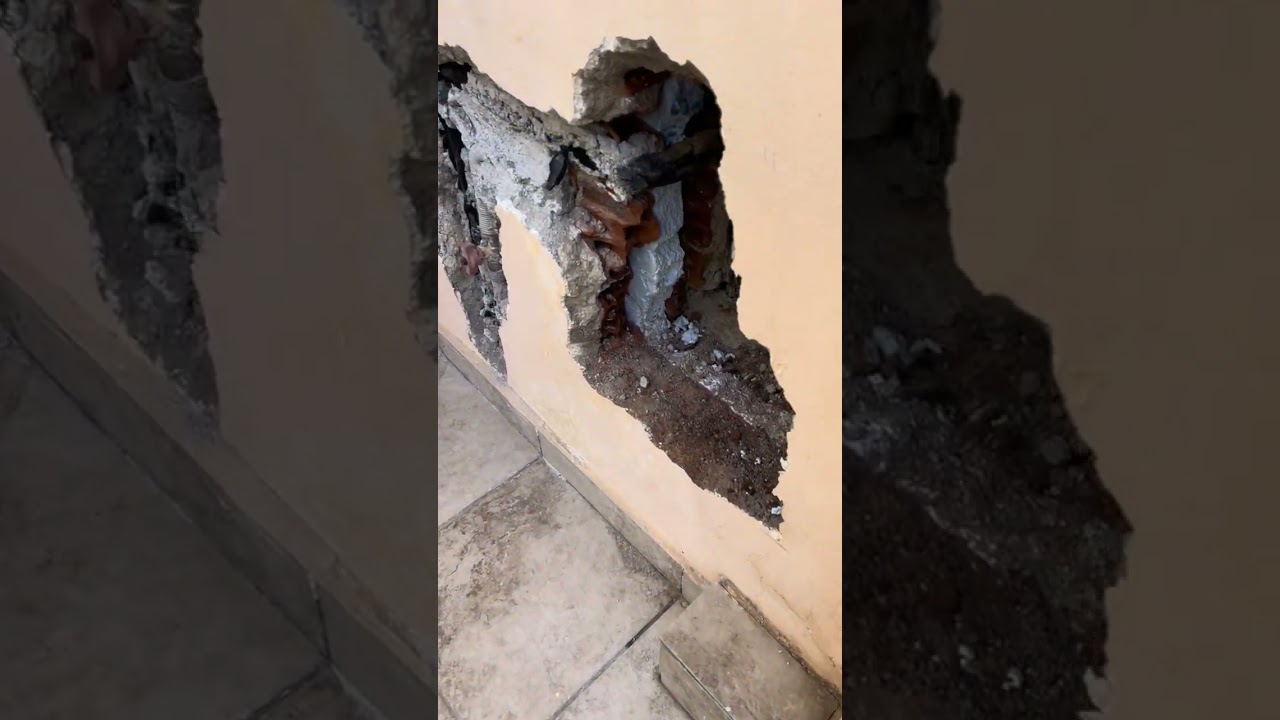
Water leaking from a pipe doesn't stay where it started. It follows gravity and the pipe, sneaks between materials, travels sideways inside the plaster or the concrete, and appears on the surface at a completely different spot — sometimes metres away from the source.
| A Real Example An owner in Pangrati sees damp on the kitchen wall. They call a plumber, who checks the sink: nothing. They think the neighbour is to blame. They call IVM. A failure is found in the heating pipe in the bathroom floor, 4 metres away from the stain on the wall. The water had travelled under the floor and risen into the wall of the kitchen next door. Solution: work at the point of the pipe. No demolition. With a thermal camera alone the result would have been unreliable, or at least insufficient with today's technology. |
Signs That the Source Is Hidden
Not all damp has a hidden source. But if you recognise even one of the following, the source isn't on the surface.
- The stain appears even when the bathroom or kitchen hasn't been used for days
- Mould returns to the same spot two or three weeks after cleaning
- A wet wall without visible pipes nearby
- Unexplained water on the floor, especially in the morning
- An unexplained increase in the water bill
- You've already called a plumber who found nothing
- Damp somewhere unexpected, such as the middle of a wall far from pipes
| If any of these apply A hidden source within the structure may be involved, requiring equipment to locate it. A plumber with a camera has one more tool than one without, but a hammer and chisel are for repair, not non-invasive diagnosis. We focus on establishing the cause first and the best outcome afterwards. |
Detection Methods Without Digging: What Works and What Doesn't
Three main methods help investigate without damage. Each has different uses and limitations.
| Method | What It Detects | Limitations |
| Wall moisture meter | Moisture at the surface or shallow depth | Doesn't see deeper than 5–8 cm; doesn't locate hidden leaks in pipes |
| Thermal camera — thermography | Maps surface thermal anomalies that may be related to damp. It doesn't measure depth and doesn't, on its own, prove the exact spot of the source | Needs a trained operator to interpret the image |
| Inspection camera | Cracks and obstructions inside pipes and ducts | Needs access through an opening; doesn't see inside the wall |
| Which Method for Which Case? For hidden damp in a wall, floor or ceiling of a home, thermography is particularly useful as a quick screening and mapping method without intervention, but the reliability of the diagnosis comes from combining the right methods for the specific case. A wall moisture meter confirms whether there is damp, but doesn't tell you where it's coming from. The endoscopic camera is used as a complement, mainly for drains. |
How a Thermal Camera Works — Without the Jargon
A thermal camera is not a night-vision camera. It detects surface temperature differences. Wet areas may be cooler than their surroundings, or warmer if the water is hot.

Think of it this way: imagine the wall coloured by temperature: orange for warm areas, blue for cold ones. Evaporation cools damp areas, revealing a contrast even when the wall looks normal.
| What a thermal camera can see | What you DON'T see without a thermal camera |
| Surface moisture effects, rather than seeing into plaster or tiles | Plaster looks dry from outside |
| Thermal traces of warm or cold pipes within a wall | The floor looks sound |
| The shape and extent of the wet area | You do not know how extensive the problem is |
| Sometimes, the direction in which water travels | You do not know where to look |
The Five Most Common Hidden Moisture Sources
Knowing the usual sources helps direct the investigation. These five account for most cases we see.
1. Water supply or heating pipes inside walls or floors
Ageing pipes, loose connections and corrosion can drip slowly and silently for months before showing on the surface.
2. Roof terraces or roofs with defective waterproofing
Rain enters the structure and appears on internal walls, often far from its entry point. Thermal imaging alone gives no clear answer here. Combined methods and, above all, an experienced engineer’s inspection may resolve it. If not, invasive investigation may be needed, but we can narrow the possibilities rather than send you to repair something unrelated.
3. Bathroom or kitchen tile joints
A worn joint lets water in every time you wash or cook. The water gets into the plaster and runs downwards — it appears lower down or on the neighbouring wall.
4. An external wall without suitable protection
Particularly in buildings over thirty years old, rain can slowly penetrate and appear indoors in winter or after heavy rainfall.
5. A leak from an upstairs or adjoining neighbour
Water can move downwards or sideways from another flat. Professional evidence is needed to establish the source, especially in a dispute.
When You Can Check Yourself — and When You Cannot
There are things you can easily check without a specialist. But for hidden sources, DIY isn't enough and you lose time that costs.
| Situation / Scenario | Without digging? | How |
| A visible drip beneath a sink or basin | Yes | Check the visible pipes and connections |
| A worn seal around a bath or shower | Yes | DIY silicone replacement, if that is the only cause |
| A wall stain without a visible source | No | Needs moisture meters, thermal imaging and other non-invasive equipment |
| Mould returning after cleaning | No | There's a hidden source — bleach won't solve it |
| An unexplained wet floor | No | Thermal imaging alone is insufficient; the source may be a pipe or ground moisture |
| A neighbour dispute requiring evidence | No | A substantiated professional report, rather than unsupported thermal images from a plumber |
| An unexplained higher water bill | No | A possible hidden leak needs professional investigation |
What Happens During the Check — What to Expect
A camera-only inspection is not enough. Professional investigation takes method, varied instruments and experience. It takes one visit rather than days, without special preparation.
- The specialist engineer arrives with professional thermal imaging and other specialist measuring equipment.
- Relevant walls, floors and ceilings are scanned.
- Cooler areas suggesting moisture are identified.
- That is where the camera’s role ends and the real skill begins: combining non-invasive methods with construction knowledge.
- Findings are related to pipe routes and the building’s construction.
- We explain the findings, most likely source and sensible next steps on site.
- Written analysis is available as an additional service. We can also arrange a call with your chosen tradesperson to explain what needs doing. First, we discuss which solution suits you. The aim is not simply to mark an X over the leak, but to find the best approach for your needs and budget.
| Without Digging — Without Surprises No tile is broken. No wall is knocked down. The diagnosis is made entirely from the surface, with non-invasive equipment. |
Why IVM — What it does differently from others, and why not to choose a plumber with a thermal camera
IVM is a specialist team of experienced engineers diagnosing leaks, mould and damp, rather than a plumbing company. That distinction matters.
| Ordinary Plumber with a thermal camera | IVM — Specialist Diagnosis |
| Checks visible taps, pipes and connections | Investigates hidden sources in walls, floors and ceilings |
| “You have two or three little leaks” — simultaneous independent leaks are exceptionally uncommon |
Uses professional thermal imaging and specialist equipment |
| «Let's replace the whole pipe» | Keeps the necessary opening as small as possible |
| Provides no formal evidence, or a report insufficient for technical assessment | Provides detailed findings for legal or insurance purposes |
Παίρνεις διάγνωση από κάποιον που δεν κερδίζει τίποτα από την επισκευή. Δεν κάνουμε επισκευές, άρα δεν έχουμε λόγο να βρούμε πρόβλημα που δεν υπάρχει, ούτε να καλύψουμε ανεπαρκή ή λάθος διάγνωση με εκτεταμένη επισκευή, που θα την πλήρωνες εσύ νομίζοντας ότι η δουλειά έγινε σωστά. Η διερεύνηση γίνεται από εξειδικευμένο μηχανικό, με επαγγελματική θερμοκάμερα και λοιπό εξειδικευμένο επαγγελματικό εξοπλισμό μη επεμβατικού ελέγχου, χωρίς να σπάσει τίποτα για να ψάξει. Τα όργανα όμως τα αγοράζει όποιος θέλει· το να ξέρεις τί σου δείχνουν θέλει χρόνια. Η IVM έχει 15 χρόνια εμπειρίας σε διάγνωση υγρασίας και εντοπισμό διαρροών σε κατοικίες και εμπορικά κτίρια (από το 2011), σχεδόν 20 σε εντοπισμό διαρροών και μη επεμβατική επιθεώρηση ηλεκτρομηχανολογικού εξοπλισμού στη βιομηχανία (από το 2006) και πάνω από 30 σε επισκευές και κατασκευές επιστημονικών οργάνων (από το 1994). Εξειδικευμένοι μηχανικοί — όχι γενικοί τεχνικοί. Πρωτοποριακές μέθοδοι που εφαρμόζονται τόσο σε ιδιωτικές κατοικίες όσο και σε μεγάλα έργα, δεν πάμε μόνο με θερμοκάμερα, είναι σα να λες ότι το μόνο μηχάνημα που έχω είναι η ακτινογραφία, πολύ χρήσιμο διαγνωστικό αλλά όλοι γνωρίζουμε για τις υπόλοιπες εξετάσεις που υπάρχουν, και δεν τις έχεις.
Clients include Coca-Cola, EYDAP, Four Seasons, AVAX, Golden Hall, Flisvos Marina, FAGE and the Hellenic Air Force. Google rating: 5.0, with over 270 reviews.
| Complete the Contact Form here! If you can't find where the damp is coming from, the quickest way to solve the problem is to talk to a specialist. Tell us what you see. First we talk, and we explain what to expect from us. |
Frequently Asked Questions, Answered
Can a thermal camera find every leak?
It detects temperature differences accurately, but that is its limit. Full equipment and expertise are needed to interpret the evidence. A leak that stopped days ago may be harder to locate, which is why we usually inspect while symptoms are active.
«My plumber said he can't find anything» — does that mean I don't have a problem?
No. An ordinary plumber checks visible points (pipes, taps, visible connections). Hidden leaks in walls or under floors aren't visible without specialised equipment. «I don't see anything» doesn't mean «there's nothing there».
Do I need to prepare anything?
No special preparation is required. Avoid excessive use of the affected facilities beforehand, and have hot water available in the water heater.
Do I receive a written report?
Detailed written findings are available as an additional service, particularly useful for disputes with a neighbour or contractor. If your insurer covers investigative work, we communicate directly with the insurer or loss adjuster, at no extra charge, and supply
whatever they need to assess compensation. We work with all insurers and have never caused a compensation problem through our work.
Much more often than most people think. In buildings over 20 years old, the water and heating pipes have completed a significant part of their life cycle. Small leaks, silent and with no visible signs for months, are one of the most common problems we see — and the most expensive if left without a diagnosis.
The fee
So that you know, before you break anything, what's wrong and which solution fits you, with a thorough non-invasive (non-destructive) check by a specialised engineer: the fee for water leak or damp detection is 410 € + VAT, with a customer satisfaction guarantee. That is: if for any reason your experience with IVM, from start to finish, didn't satisfy you, you ask for your money back, whenever you want (see our guarantee →). We explain the findings to you on the spot and discuss them together. We investigate one cause, wherever it takes us (what this means →). Your space stays as it was.
That's all for the visit. If there is an insurance policy, we contact its loss adjuster ourselves and send them whatever material they need to make use of the visit, at no extra charge. Only if you also want something in writing for your own reasons, which is optional, there is an extra fee: a technical report stamped by an engineer, 150 € + VAT, or an expert-witness report by a qualified engineer, 300 € + VAT (what each one includes →).
The fee applies from Voula to Kifisia, for homes up to 180 m². For business premises, homes over 180 m² and areas outside this zone, we start from the same fee and the specialised engineer will confirm it when they talk to you — before the appointment. Full details of our fees →
Tell us what you see or call us on 210 513 8501.